Sam Kondrin
Because the north is far from the south,
our thoughts are clinging to one another
— Joseph Brodsky
In The Unbearable Lightness of Being, Milan Kundera poses a question: ‘Can proximity cause vertigo?’ In the Gulf of Alaska, near the settlement of Yakutat—according to the accounts of a leader of one of the clans that inhabited it in the 18th century [1]—there stood a tree to which one could press an ear. If a vibrating sound emanated from the wood, crossing the glacier was deemed hazardous due to a potentially approaching storm. How is Arctic proximity connected to its cartographies, and can it, indeed, cause vertigo? Let us address this question from the perspective of sonic epistemologies discovered in the North.
Once terra incognita, the spaces of the North and the Arctic are being developed, settled, and demarcated. Defined as Niflheim ‘World of Mist’ during the era of the Poetic Edda, they have become increasingly illuminated and mapped throughout history. But how does this mapping occur? Who decides what and how to display on a map, and what names to give the objects encountered along the way? And what remains nameless and excluded from this cartography?
Cartographic traditions (including acoustic ones) are, first and foremost, epistemic processes, the analysis of which allows us to trace the intellectual history of the use of distal and proximal senses in the production of knowledge. In the modern period, maps and other visual technologies of representation (globes, tables, texts) emerge as methods for the mental apprehension of that which is not given to the gaze instantaneously or momentarily. Cartography becomes a surrogate that, on the one hand, serves as a visual interface for a space that is impossible to synthetically master with vision, and on the other, as a project of a politico-epistemological regime representing power as a subject of visual and interpretative control. The globe and maps establish themselves ‘as a model object of political and epistemological claims and simultaneously as an imperative: 'to dominate is to see,' including what is happening far away in other places’ [2]. As Bruno Latour notes, the transfer of land onto paper allows for the translation of distant territories to the center without taking them along [3]—the map becomes an ‘immutable mobile,’ enabling a shift between a remote location and the gaze of an observer positioned at a distance.
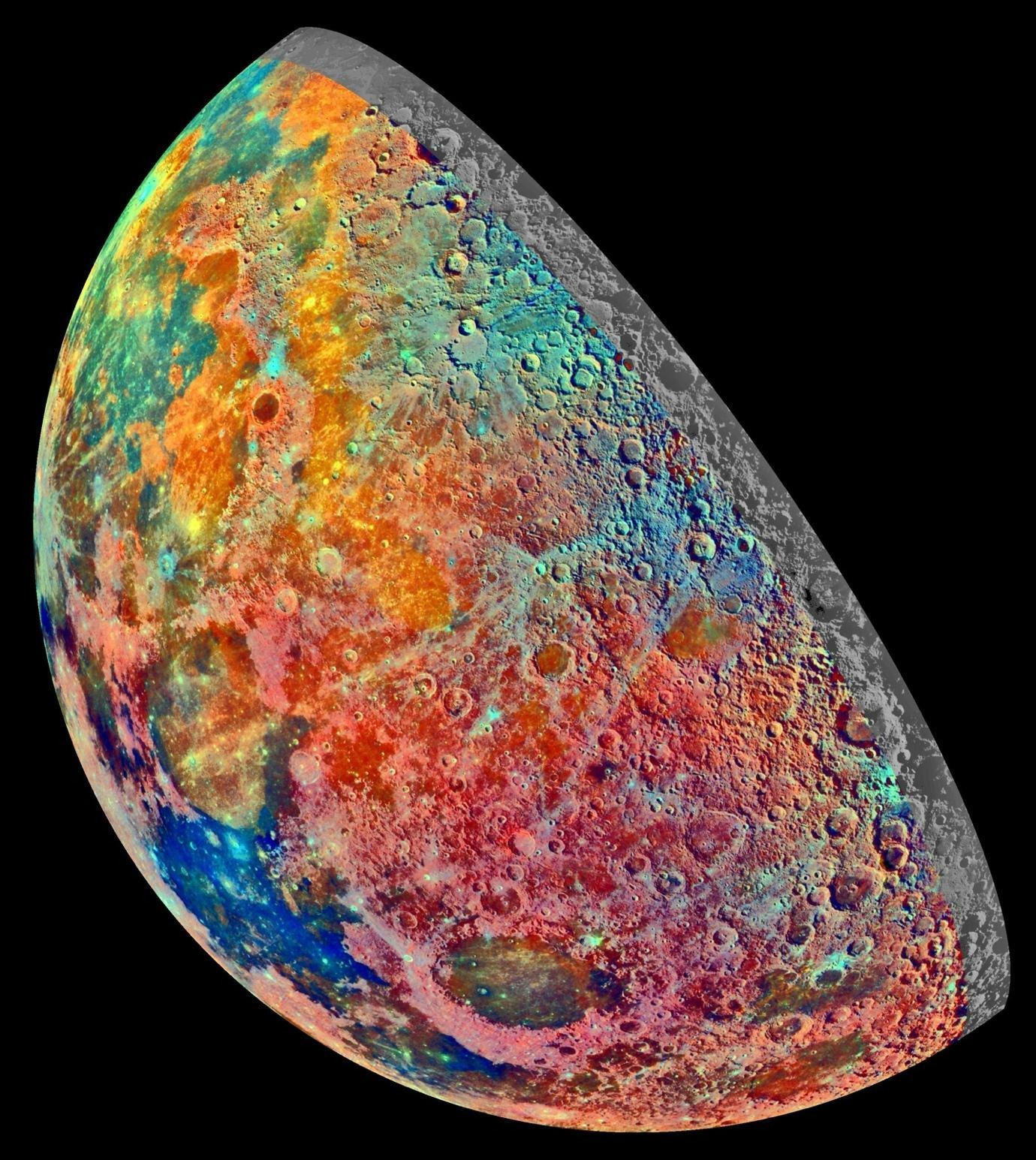
At the same time, as a method of establishing control over a territory, cartography—which succeeded cosmography (i.e., the technique of describing space as a dualistic relationship between the perspective of a human situated on the Earth's surface and a disembodied divine gaze located beyond the Earth and looking down upon it from space)—continues, much like cosmographic mythopoesis, to allow for conventions and interpretative systems. Within these paradigms, the seemingly continuous Earth acquires a discrete character, being expressed and represented through socio-technical methods on the one hand and artistic methods on the other. For instance, in contemporary space mapping, representation and rendering technologies that capture the colors, temperatures, and textures of cosmic objects and atmospheres encounter representational limits; beyond this line, practices that are essentially cosmographical in nature take effect, translating extraterrestrial reality into terrestrial language. In other words, extraterrestrial geographies encounter conditions of materiality that necessitate, on the one hand, a revision of the very idea of the material and, on the other, the use of marginal languages of description that differ little in their structure from the mythopoetic languages used to describe distant lands in the era before remote sensing techniques. Thermal imaging of the lunar light spectrum, atmospheric modeling, False Color Imaging (see Appendix 1), and astrophysical simulations were anticipated by ancient and medieval methods of representing textures, colors, and sounds inaccessible to the reception of the Western European subject—such as cosmological depictions of the world, visualizations of the monstrous in places hidden from view, or the description of the North as an abyss. But if cosmographical methods of representation, aesthetically detectable in modern scientific research techniques, are included in the dispositif of knowledge production about the Earth and space, then is it possible for tacit sonic epistemologies to exist as alternative measures of the Northern territories?
In Sonic Epistemologies [4], sound studies researcher Holger Schulze develops a model of the relationship between professional and everyday auditory knowledge, where the former is directed toward recording the properties and characteristics of sound, while the latter uses sound itself to generate knowledge derived from it. In other words, sonic epistemologies involve the production of sonic knowledge, or knowledge obtained through and by means of sound. According to Schulze, tacit knowledge—in the form of everyday practices of listening and using sound to obtain non-sonic knowledge—offers a space of resistance within which alternative ways of archiving cognitive experience, outside the socio-technical dispositif, become possible. Such tacit epistemologies exist on the peripheries of scientific dispositifs or are excluded from them entirely; they circulate within the everyday, where, through sound and collective auditory experience, it is possible to gain access to knowledge that remains closed to formal, institutionalized forms of knowledge localized in conventional scientific settings.
Jeremy W. Crampton describes a field of tension within the practices of geographic knowledge formation between ‘expert’ and ‘amateur’ epistemologies (see Appendix 2). Crampton refers to expert, certified, and institutionalized scientific knowledge—with its characteristic artifacts of academic work—as a state of securitization, regulation, and centralization of geographic knowledge. Conversely, communities of ‘amateurs’ and actors lacking specialized geographic skills and competencies challenge ‘expert’ knowledge. By forming what Crampton defines as a field of resistances, they bring about the death of expertise, which loses its resource for the unconditional ownership over the production of topographic knowledge. Thus, a trend toward a return to cosmographic epistemologies is observed, allowing for the integration of aesthetic and academic modes of collective imagination regarding the Northern space, including through sound.
The Polar Sounds project [5], as part of the Cities and Memory sound mapping initiative, offers a collection of recorded sounds from various events associated with the Arctic. Field recordings of ice cracking, the roar of collapsing icebergs and sliding ice shelves, and the voices of whales and seals—stripped of intentional acts of representation and staging—allow for the transmission of acoustic atmospheric knowledge of the Arctic region through methods of sonic fidelity and undistorted presentation. The distal relations of the ‘world’ with the Arctic acquire a proximal expression of the non-represented material-affective atmospheres of those Northern territories which, throughout the history of visual cartography, were confined to the peripheral areas of knowledge.
In the second half of the 20th century, Canadian pianist Glenn Gould created the radio documentary Solitude Trilogy. It is an hour-long work that brings together recorded oral accounts from several of the composer's informants regarding their sense of isolation in the Arctic regions of Canada. The storytellers' voices are combined and directed in such a way that they overlap, enter into acoustic conflict, and either coincide or diverge in key, intonation, and timbre. Gould's objective was to create a sonic work that, through its absence of narrative, could produce sound effects that transmit atmospheric knowledge of isolation. In Trilogy of Solitude, the key element is not the content of the narrative, but the contrapuntal interaction of the narrators' voices’ acoustic properties: through their reverberation, speech rhythms, and pre-communicative effects, a non-representational aesthetic message about isolation in the Arctic is realized.
Another example of sonic epistemologies that produce alternative cosmographic knowledge of the North is the Sámi joik—a semi-improvised pentatonic singing that brings the performer's voice into resonance with nature (for instance, with the howling of the wind), resulting in the acoustic synchronization of the acoustic territories of the human and the non-human. A distinctive feature of the joik is its lack of content and its lack of address toward any specific object—the joik itself is the expressed entity entering into a relationship with an anonymous sonic flux. Such unstructured singing fits into the logic of the tacit sonic skills described by Schulze and the state of resistances defined by Crampton.
In her 2024 album The Singing Ice of Storsjön, Swedish sound artist Jonna Jinton uses the sounds of Arctic ice that are barely audible in everyday life: cracking, thundering, and the noises of moving ice surfaces. With minimal direction or organization of this sound, Jinton, using ultra-sensitive microphones, approaches the ice not as an object of recording and listening, but as an actor in an acoustic event. The ice is neither documented nor represented; rather, it participates in sonic territorialization, thereby displacing distal cartographic regimes and offering, in their stead, proximal aesthetic epistemologies that allow the recipient to connect with the atmospheres of Northern territories. In this case, the sounds of the ice function in a mode of counter-cartographic reverberations: sharp shifts in sonic events reveal the discreteness and mobility of the North, appealing to tacit forms of acoustic knowledge.
Scottish artist Katie Paterson, in her projects related to the nanopolitics of Arctic glacial spaces and their integration into the structure of global climate change, implements an example of counter-cartography that records the disappearance of Arctic territories. In 2007, the artist recorded the sounds of three melting Icelandic glaciers—Langjökull, Snæfellsjökull, and Sólheimajökull—which she then transferred onto vinyl records made from the very water of those same glaciers. These records were played in front of an audience and performed until they melted and vanished. In the process of sounding and realizing the sonic act, this acoustics demonstrated its own destruction, metaphorically representing the devastation faced by the ice sheets of the North in the context of global climate change. The glaciers became neither objects of contemplation nor mere referents, but direct actors producing sound and disappearing in real time—a process that, on a different scale, parallels the disappearance of the glaciers themselves. An Icelandic telephone line connected to one such glacier allowed anyone, at any moment and from anywhere in the world, to listen to the sounds of the glacier melting; this forms an aesthetic epistemology that realizes a proximal way of detecting space. This space does not merely exist on a map in a fixed state; rather, in its process of becoming and deformation, it is not identical to itself across different periods. Sonic aesthetic epistemologies in this regard allow for the recording of such non-identity, mobility, variability, discreteness, and fragility.
Sea ice, or siku in Inuktitut, serves within Inuit communities as a communicative semiotic space that enables, among other things, sonic orientation across acoustic territories: ‘We hear the music of the sea ice, the niiqquluktuq (ice rubbing sound), the puff of air when a seal rises to breath in its aglu, and the 'Uuuua, uuuua, hut-hut-hut!' of the qimuksiqtiit (dog teamers)’ [6]. In Inuktitut dictionaries, one can find an entire category of words describing various acoustic situations, which are integrated into the corpus of auditory tacit knowledge used by indigenous inhabitants. For example, ‘iułuk’ [7] (‘ᐃᐅᓗᖅ’ in Inuktitut) denotes a specific type of ice sound heard when ice floes collide or pile up. Such a definition in the language describes an acoustic phenomenon and becomes a sonic skill used by Inuit hunters to monitor the state of the sea ice; based on the character of this sound, it is possible to determine the pressure and the degree of mobility of the frozen sea cover, which is one of the most critical factors in safety protocols for traveling across icy surfaces.
Thus, sonic epistemologies, empathetic non-understanding, and intentional non-representation realize proximal, tacit forms of knowledge. Unlike the visual epistemologies that consolidated their positions during the modern period, sound—and the production of knowledge through it—brings the human ear and mind closer to the North. The Arctic can be fixed upon a permanent medium, but it can also be placed within the volatile medium of sound, which by its very nature realizes, on the one hand, the discreteness of the North as an object of geographic representation, and on the other, its continuity as an object of ontological representation—ultimately approaching its end, not least through the apocalyptic history of the contemporary age.
So, can proximity (in our case, auditory one) cause vertigo? Kundera’s answer to this question is as follows: ‘It can. When the north pole comes so close as to touch the south pole, the earth disappears and man finds himself in a void that makes his head spin and beckons him to fall’. Our answer to this question is this: tacit sonic epistemologies, as an experience of the proximal mastery of the North Pole, complement the socio-technical dispositif with epistemological archives of everyday auditory experience, thereby perfecting human knowledge and bringing it closer to its end. At the same time, humanity itself is approaching its end, moving along a path of self-destruction and total annihilation, coupled with the attainment of perfection (that is, the attainment of the divine, and thus, the no-longer-human) through the acquisition of absolute knowledge. Proximal epistemological regimes, overcoming distal experience, will allow us to hear and know more and closer—but proximal modes of cognition (and their more perfected and completed forms) will bring man closer to the North and South poles, bringing the poles themselves together, which, among other things, converge during the unfolding of the apocalypse (in the form of the atomic bomb and global climate change, for instance). The final epistemological act of man will infinitely approximate him to the Earth's poles, which will infinitely converge following man—and as a consequence:
Everything will perish, everything will vanish
From the bacillus to the elephant—
And your love, and your songs,
And the planets, and the moon.
Bibliography
Cruikshank J. (2005) Do glaciers listen? Local knowledge, colonial encounters, and social imagination. Vancouver: UBC Press. P. 36.
Gavrilenko S. (2023) The world on the surface: ‘The Ambassadors’ and the terrestrial globe of Hans Holbein the Younger (Mir na poverkhnosti: «Posly» i zemnoy globus Gansa Gol'beyna Mladshego) // Logos. Vol. 33. No. 1. P. 180.
Latour B. (1987) Science in action: how to follow scientists and engineers through society. Cambridge: Harvard University Press. pp. 63–100.
Schulze H. (2024) Sonic epistemologies // Groth H., Murphet J. (Eds.) The Edinburgh companion to literature and sound studies. Edinburgh: Edinburgh University Press. pp. 351–365.
Polar sounds // Cities and Memory portal (https://citiesandmemory.com/polar-sounds/).
Krupnik I., Aporta C., Gearheard S., Laidler G. J., Holm L. K. (Eds.) (2010) SIKU: knowing our ice. Documenting Inuit ice knowledge and use. Dordrecht: Springer. pp. ix–x.
Krupnik I., Aporta C., Gearheard S., Laidler G. J., Holm L. K. (Eds.) (2010) SIKU: knowing our ice. Documenting Inuit ice knowledge and use. Dordrecht: Springer. P. 348
Appendix 1
Appendix 2
